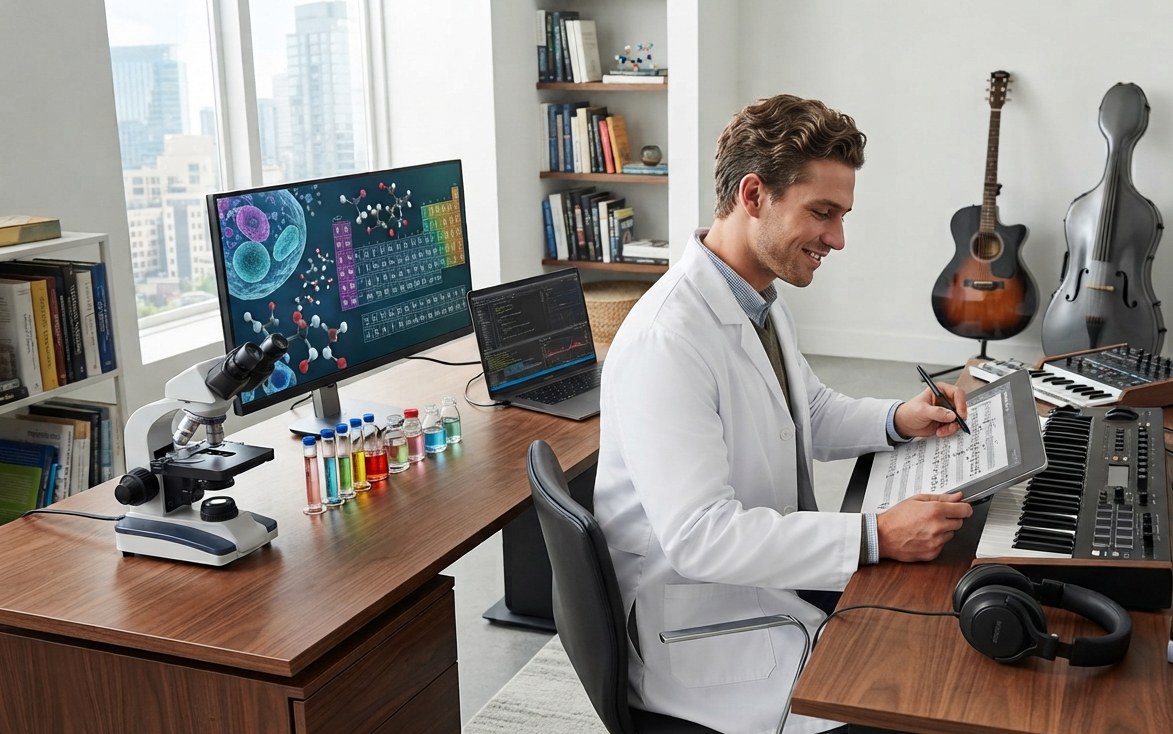
For me they complement each other and in many ways feed each other, too.Denny Zeitlin, psychiatrist, pianist, and composer
Science and music may seem very different. Science often uses experiments, evidence, and logic, while music may seem to be about imagination, emotion, and creativity.
But some people have been successful in both worlds. Some scientists and doctors were also musicians. A few even composed serious music while continuing demanding careers in science or medicine.
Their stories show something important: you do not have to choose between being analytical and being creative.
Theodor Billroth, Surgeon and Composer
Theodor Billroth (1829 to 1894, Germany) was a famous surgeon who was also deeply involved in music. He studied medicine at the Universities of Greifswald, Göttingen, and Berlin and completed his medical degree in Berlin.
Billroth became one of the leading surgeons of the 19th century. At the same time, music remained an important part of his life. He played the piano and violin, studied music seriously, and composed his own works.
Billroth was also a close friend of the famous composer Johannes Brahms. Brahms trusted his musical judgment and sometimes shared new works with him before they were published. Brahms even dedicated his first two string quartets, Op. 51, to Billroth.
Most of Billroth’s own compositions have been lost, but one surviving song, Todessehnsucht, gives us a rare example of his music.
Alexander Borodin, Chemist and Composer
Alexander Borodin (1833 to 1887, Russia) was both a composer and a scientist. He studied medicine at the Imperial Medico-Surgical Academy in St. Petersburg and later earned a doctorate.
Today, Borodin is remembered as an important Russian Romantic composer and a member of The Five, a group of composers who wanted to create a distinct Russian style of classical music.
His works include Symphony No. 2, two string quartets, and the unfinished opera Prince Igor, which includes the famous Polovtsian Dances.
But Borodin was also a physician and chemist. He became a chemistry professor and carried out scientific research. For much of his life, he had to fit composing around his work in science.
Morris Kates, Biochemist and Composer
Morris Kates (1923 to 2013, Romania and Canada) was a biochemist, violinist, and composer. He studied physics, chemistry, and biochemistry at the University of Toronto while also continuing his musical studies.
Kates began playing the violin at age 11 and started composing at 16. Even while studying science, he continued learning harmony, counterpoint, and composition.
Kates later had a scientific career lasting about 50 years at the National Research Council of Canada and the University of Ottawa, where he eventually became Professor Emeritus of Biochemistry.
But he never gave up music. He continued composing throughout his scientific career, creating chamber music, orchestral works, vocal music, and pieces for individual instruments.
Lejaren Hiller, Chemist and Composer
Lejaren Hiller (1924 to 1994, United States) was a chemist, composer, and early pioneer of computer music. He earned his bachelor’s, master’s, and doctoral degrees in chemistry from Princeton University while also studying music composition.
After earning his Ph.D., Hiller worked as a research chemist at DuPont and later joined the chemistry faculty at the University of Illinois. While teaching chemistry, he continued studying composition and later earned a Master of Music degree.
Then his two interests came together. Hiller began experimenting with ILLIAC (Illinois Automatic Computer), an early computer at the University of Illinois. Working with Leonard Isaacson, he used the computer to help create the Illiac Suite for string quartet, one of the early important examples of computer assisted composition.
Hiller used ideas from science, mathematics, and computers as part of his music making process.
Alâeddin Yavaşça, Physician and Composer
Alâeddin Yavaşça (1926 to 2021, Türkiye) was both a doctor and an important composer and performer of Turkish classical music. He graduated from Istanbul University Faculty of Medicine and later specialized in obstetrics and gynecology at Haseki Hospital.
Yavaşça worked for many years as a physician and later served as a hospital chief physician.
At the same time, music remained a major part of his life. He became a singer, teacher, and composer and wrote hundreds of works in many forms of Turkish classical music. Among his well known compositions are Şen Gözlerinle Yüzüme Bir Baktın and Kimseyi Böyle Perişan Etme Allah’ım Yeter. His music used many traditional makams. Yavaşça continued creating music while working in medicine. His medical and musical careers were not separate parts of his life, they developed side by side.
makam (n.) a Turkish musical mode with its own characteristic notes and melodic movement.
Denny Zeitlin, Psychiatrist and Composer
Denny Zeitlin (born 1938, United States) is a psychiatrist, jazz pianist, and composer. He graduated from the University of Illinois and received his M.D. from Johns Hopkins University. Zeitlin later became a professor of psychiatry at the University of California, San Francisco.
At the same time, he built a professional career in jazz as a pianist and composer. Zeitlin has recorded many albums, performed internationally, composed original music, and even wrote music for Sesame Street.
What makes his story especially interesting is that he did not leave medicine in order to become a musician. He continued doing both. Zeitlin has also spoken about the connection between psychology and musical creativity, bringing his two careers together in another way.
Lucy Jones, Seismologist and Composer
Lucy Jones (born 1955, United States) is a seismologist, musician, and composer. She earned a B.A. from Brown University and a Ph.D. in Geophysics from the Massachusetts Institute of Technology (MIT).
Jones spent more than three decades working as a scientist with the U.S. Geological Survey. Today, she is the Founder and Chief Scientist of the Dr. Lucy Jones Center for Science and Society and a Research Associate at Caltech’s Seismological Laboratory.
Music has also been an important part of her life. She plays the viol, an early string instrument, and performs Baroque music.
Jones brought science directly into one of her compositions, In Nomine Terra Calens. In this work for four viols, she turned global temperature data into musical notes, so the musical line rises as the Earth’s temperature rises. She later founded TEMPO: Music for Climate Action, which brings scientists and musicians together to use music to communicate ideas about climate change.
Anna Lindemann, Biologist and Composer
Anna Lindemann (United States) is a biologist, composer, animator, performer, and educator. She is currently an Associate Professor of Digital Media & Design at the University of Connecticut. She graduated from Yale University with a B.S. in Biology and later earned an M.F.A. in Integrated Electronic Arts from Rensselaer Polytechnic Institute.
While studying biology at Yale, Lindemann worked in an evolutionary developmental biology lab and researched butterfly wing patterns. She later began using biology not only as a subject for her art, but also as a way to create music.
In works such as Theory of Flight, Bird Brain, and The Colony, she combines music, animation, performance, and scientific ideas. She has also created electronic music using computer based systems inspired by biological development.
Her work shows a different way science and composition can come together: biology can become both the subject of music and part of the method used to create it.
References
- Habets, A. (1895). Borodin and Liszt: I. Life and Works of a Russian Composer; II. Liszt, as Sketched in the Letters of Borodin. Translated by Rosa Newmarch. London: Digby, Long & Co.
- Vik, T. (1998). Alexander Borodin, Physician, Chemist, Scientist, Teacher and Composer. Tidsskrift for den Norske Lægeforening, 118(30), 4693 to 4696.
- T.C. Kilis Valiliği. Alaeddin Yavaşca.
- Türkyılmaz, F. (2021, December 23). Türk Müziğinin Gönül Ustası: Alaeddin Yavaşca. Anadolu Ajansı.
- Alaeddin Yavaşca official website.
- University of Illinois Archives. Hiller, Lejaren (1924 to 1994).
- University of Illinois Distributed Museum. ILLIAC Suite.
- Lin, T. Y.-Y., & Seal, A. (2021). Theodor Billroth: Surgeon, Musician, and Composer. The American Surgeon, 87(4).
- Lott, M. S. (2012). At the Intersection of Public and Private Musical Life: Brahms’s Op. 51 String Quartets. Journal of the Royal Musical Association, 137(2), 243 to 305.
- Zeitlin, D. Biography. Denny Zeitlin official website.
- Zeitlin, D. Unlocking the Creative Impulse: The Psychology of Improvisation. Denny Zeitlin official website.
- Canadian Music Centre. Morris Kates (1923 to 2013). CMC Composer Collection.
- Dr. Lucy Jones Center for Science and Society. (n.d.). Climate Music Initiative.
- Dr. Lucy Jones Center for Science and Society. (n.d.). TEMPO: Music for Climate Action.
- Climate in Arts and History. (2023). Tempo: Music for Climate Action.
- Lindemann, A. (n.d.). About & Contact. Anna Lindemann official website.
- University of Connecticut. (n.d.). Anna Lindemann. Digital Media & Design faculty profile.
- Yale University. (2013, February 22). Art and Science Converge in Multidisciplinary Art Performance. Yale News.