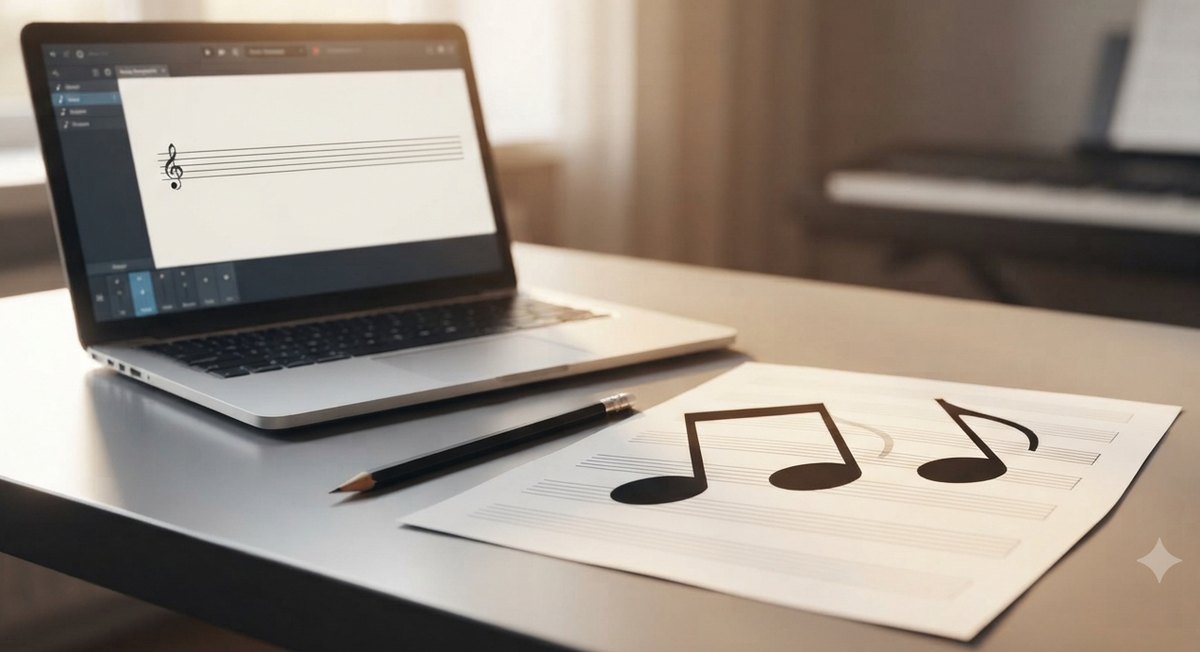
The Blank Page Problem
Every composer starts with a blank page. The cursor blinks on an empty screen. Whether you are using notation software such as Finale, MuseScore, Sibelius, or Dorico, or looking at a blank sheet of manuscript paper, the first measure can be the hardest one to write.
Sometimes the problem is that you have no ideas. Other times, you may have dozens of melodies, rhythms, and harmonies in your head, but none of them seem to fit together. I had this issue before I made my first song in 2017.
The solution does not have to be finding an entire piece. Sometimes, you just need to find three notes.
History's First Steps
Even the composers we now consider musical giants had to begin with small ideas.
At age eleven, Ludwig van Beethoven published his first composition, Nine Variations on a March by Ernst Christoph Dressler, WoO 63. Rather than beginning with one of the enormous symphonies for which he would later become famous, young Beethoven worked with a simple existing melody and explored how it could be transformed through variation.
Wolfgang Amadeus Mozart also began with very small keyboard pieces. At age five, he composed works including Andante in C Major, K. 1a. He was still too young to write the music down himself, so his father, Leopold Mozart, helped record his compositions.
The masterpieces came later. The first step was simply learning what could happen when a small musical idea was explored.
The Power of Three
A better goal is not to write an entire composition today, rather to find your first three notes. Those three notes do not have to be perfect, nor complicated. They simply have to give you somewhere to begin. Try three notes with any rhythm. Try playing them backward and see if that improves. Or change their rhythm. And my favorite suggestion, transpose them, which means making them higher or lower in the register.
After the three notes, what should happen next?
A surprisingly large musical idea can grow from a very small starting point.
Finding Your Foundation
Every composer develops a different workflow.
Some prefer the physical feeling of pencil and manuscript paper. Others like the immediate feedback of notation software. Some begin at the piano, while others start by humming a melody or imagining a rhythm.
The tool matters less than the decision to begin.
At PieceFoundry, I encourage young composers to start small and allow their ideas to develop gradually. A three note idea might become a melody. That melody might suggest a second phrase. Eventually, those phrases can develop into sections, and those sections can become a complete composition.
Use your musical intuition. Experiment. Listen. Change things. Try again.
There is no requirement to know where the piece will end before you write its beginning.
Start With Three
To conclude, while a blank page can make a full composition seem impossible, three notes are much less intimidating. You do not need your entire piece today, you only need a beginning.
Every composition starts somewhere. Yours can start with three notes.
Start writing today at PieceFoundry.
References
- Lockwood, L. (2003). Beethoven: The Music and the Life. W. W. Norton & Company. ISBN 978-0-393-32638-3.
- Solomon, M. (1995). Mozart: A Life. HarperCollins. ISBN 0-06-088344-8.