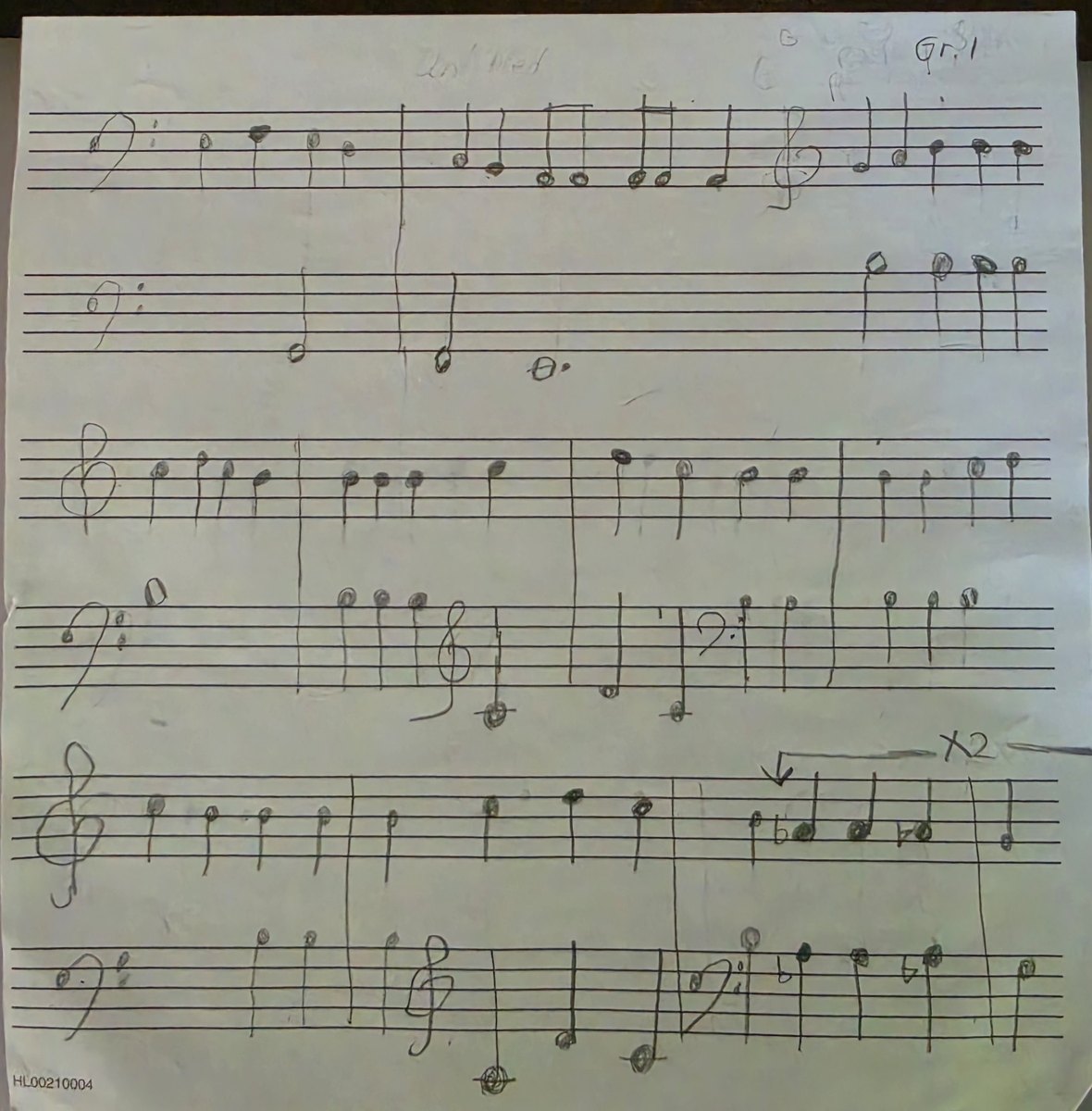
I still remember sitting at my keyboard at age seven, curious about what I might be able to create. All I had was my keyboard to create music. I was not following a textbook or imitating a particular composer. I simply tried different notes and techniques until something unexpected caught my interest. I spent much of my winter break searching for melodies, repeating them, changing them, and seeing where they might lead.
Eventually, one of those melodies became the beginning of my first composition, Number 8.
That experience changed the way I thought about music. While this was not the first time I tried to create music, it was the first successful attempt at creating music. Previously, my music was very fragmented, meaning the ideas of my music were not united under one idea. But my first composition, Number 8, had various rhythms and beats that were united under the idea about Number 8.
Learning by Experimenting
Again, my first composition was really a collection of musical ideas.
I did not understand much of the theory behind what I was doing. What do I mean by theory? In music, chords, rhythms, and patterns are standardized and defined by some unifying theory of music. I was building patterns, experimenting with symmetry, repeating ideas, and changing notes simply because I liked the way they sounded instead of the theory behind it.
Finishing the piece was the hardest part, because not every composition has a natural ending place. I did not yet understand how to bring a piece to a satisfying conclusion. I tried returning to a melody from the beginning of the piece. Without knowing the terminology, I had discovered something composers use all the time: bringing earlier musical material back to create a sense of unity.
That was one of my first lessons in musical structure.
From Memory to Musical Notation
While I was making the song, I did not write the piece down. Instead, the entire composition existed in my memory. I could play it from beginning to end, but I did not yet know how to properly notate a complete piece of music.
When my piano teacher encouraged me to submit Number 8 to a composition contest, I was required to turn everything I had memorized into an actual written score.
It took me about five days to write the entire piece by hand, because using digital software is even harder in terms of learning it.
Eventually, I learned to use Finale for digital music notation, which made life easier because instead of keeping ideas only in my head, I could place them on a page, hear them back, make changes, and experiment more easily.
It turns out that notation itself became part of the creative process. I began to see patterns in music more clearly because of practice and how easily the software replays everything. The way rhythms fit together, how musical ideas repeat and transform, and how a piece can be organized almost like a work of art.
That integration between creativity and structure is still one of the things I enjoy most about composition.
From Solo Piano to Chamber Music
For many years, I mainly wrote music for solo piano.
More recently, through further composition study, I began writing for other instruments as well. I have explored works for piano and clarinet duo and for piano trio with violin and cello.
Writing for multiple instruments introduced an entirely new challenge. Instead of thinking only about one musical line or one instrument, I had to consider how different parts could interact, respond to one another, and create a larger musical texture.
Exploring chamber music has shown me just how much more there is to learn.
Why This Matters to PieceFoundry
When I think back to Number 8, I remember how much of the process I had to discover through experimentation instead of theory. Every young composer needs room to explore, make mistakes, and discover ideas on their own.
However, guidance can make those first steps much less intimidating and more practical.
That is one of the reasons I created PieceFoundry. I want young composers to have a place where they can experiment independently while also receiving support when they need it. Remember, your first composition does not have to be perfect.
What will your first composition sound like?